
woman, interrupted
"motherhood", "insanity", etc. in lynne ramsay's DIE MY LOVE; or: LET JENNIFER LAWRENCE HATE HER BABY
The film itself makes just one clinical-ish reference to what Grace is experiencing, when someone says how common “postnatal depression” is. The press tour largely referred to it as “postpartum depression”, and different reviews I’ve seen online have variably diagnosed her with either bipolar disorder or borderline personality disorder or “depressive psychosis”. This is more an observation on the film’s reception, but I think it does reflect a certain refutation of materiality in the film itself, as Grace is placed solely inside of her own head without any clear contextualisation in the world — except with her son, purely as an extension of her own being (in a way I found almost sinister).
With its disavowal of the significance of any diagnostic specificity, this is, for all intents and purposes, a movie about a woman going generally crazy in no particular direction. As Alise Chaffins writes, “[Die My Love] can read more as a “bitches be crazy” film than a deep look at the mental health struggles of a woman with PPD [postpartum depression].” And without being crass, I would be remiss not to point out that in this nonspecific, ill-defined (not necessarily a bad thing) craziness, she is routinely possessed to take her clothes off and act in hypersexualised ways that we as viewers might perceive as kindly as we like – but this kindness will have to fight through the lack thereof in the camera, in the narrative, and in the film’s construction of what it means to be insane.
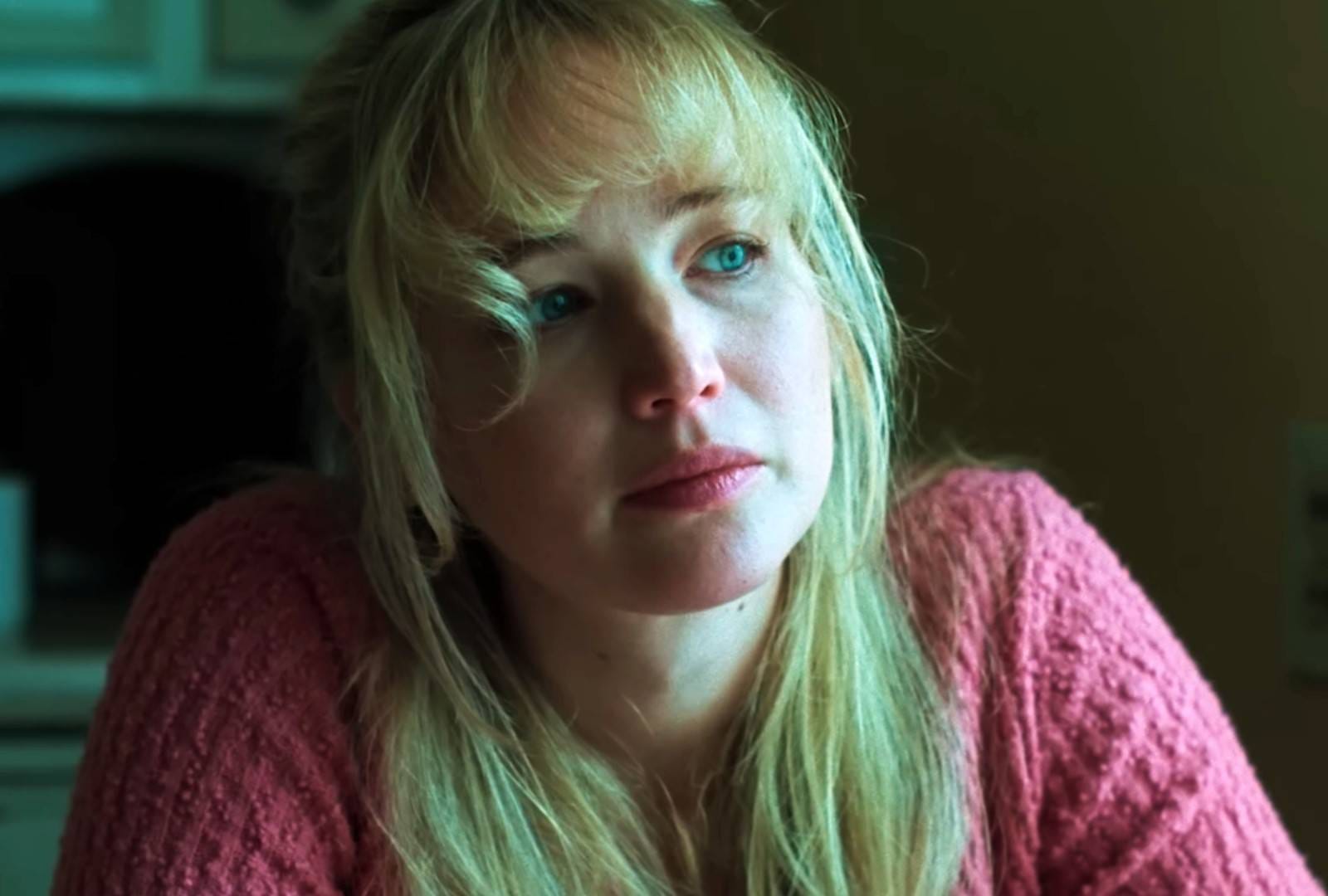
“With an aflame Lawrence in its crosshairs, it casts a nauseating, hypnotic spell, plumbing the power of its domestic imprisonment story to the deepest depths,” writes Rory Doherty, describing the tactility and immediacy of how the film feels in the body, in the mind. This muddiness serves the film by obscuring and in places confusing the specifics of it all: Jackson’s job, the strength of anyone’s tether to real life, the baby’s name for most of it, pointedly, and Grace’s state of mind, too. Ultimately, the lack of clarity in the film is not an inherent negative, but ends up being the unwelcome product of a disregard of what it feels like to feel how Grace is feeling – she is instead hollowed out in service of startling, even gratuitous gestures to her instability, held precariously, torturously away from safety and agency at every turn.
Somewhere through the middle of the film, I found myself recoiling from how this unwellness, “whatever Grace may be suffering from”1, was portrayed, at first simply distorted and deranged and ultimately nonsensical, destabilising, out of touch not just with reality but with its own logics. I couldn’t put my finger on why I felt so put off, upset, even, because each of these adjectives and descriptors are in fact completely in line with the shapes illness can, and does, take – shapes that are often painfully and violently plastered over in our artistic, cultural, social, and clinical imaginations. But then it came into slightly sharper focus as the camera itself continued to descend into blurs and jump cuts: the film had not misunderstood this state of insanity or its analogues, it had instead metabolised it into its own narrative priorities and produced something that was not grotesque because it was painful, terrifying, dangerous, but something that was grotesque because it was shocking.
This is not a new model of storytelling, and “shock value” and “gratuitous nudity” are not new ideas. The couple’s voyeured introduction (one alluded to frequently in its critical reception) sets them up as subject (submissive, supplicant) to our gaze, the camera’s gaze, at the outset —
We are already inside the house when its new owners arrive. The opening shot of Die, My Love shows the ground floor of a remote home in perfect stillness, left dormant by its former owners. We watch from a fixed position (does the house see them too?) as a buoyant young couple cross the threshold, and survey how much renovation the house will need.2
And the film’s ever-accelerating progression in its emotive rhythm continued this framing, as we watch the two have violent, chaotic sex from the outside of their entanglement, and we watch a nearby biker watching Grace, as we watch her crawl to her baby with a knife in her hand and leave it there unattended. Each narrative movement neither deepened nor sustained the plot, but simply underscored the protagonist’s mental state as a matter of instructional reminders, actions clinical in their sterility and empty in their meaning.
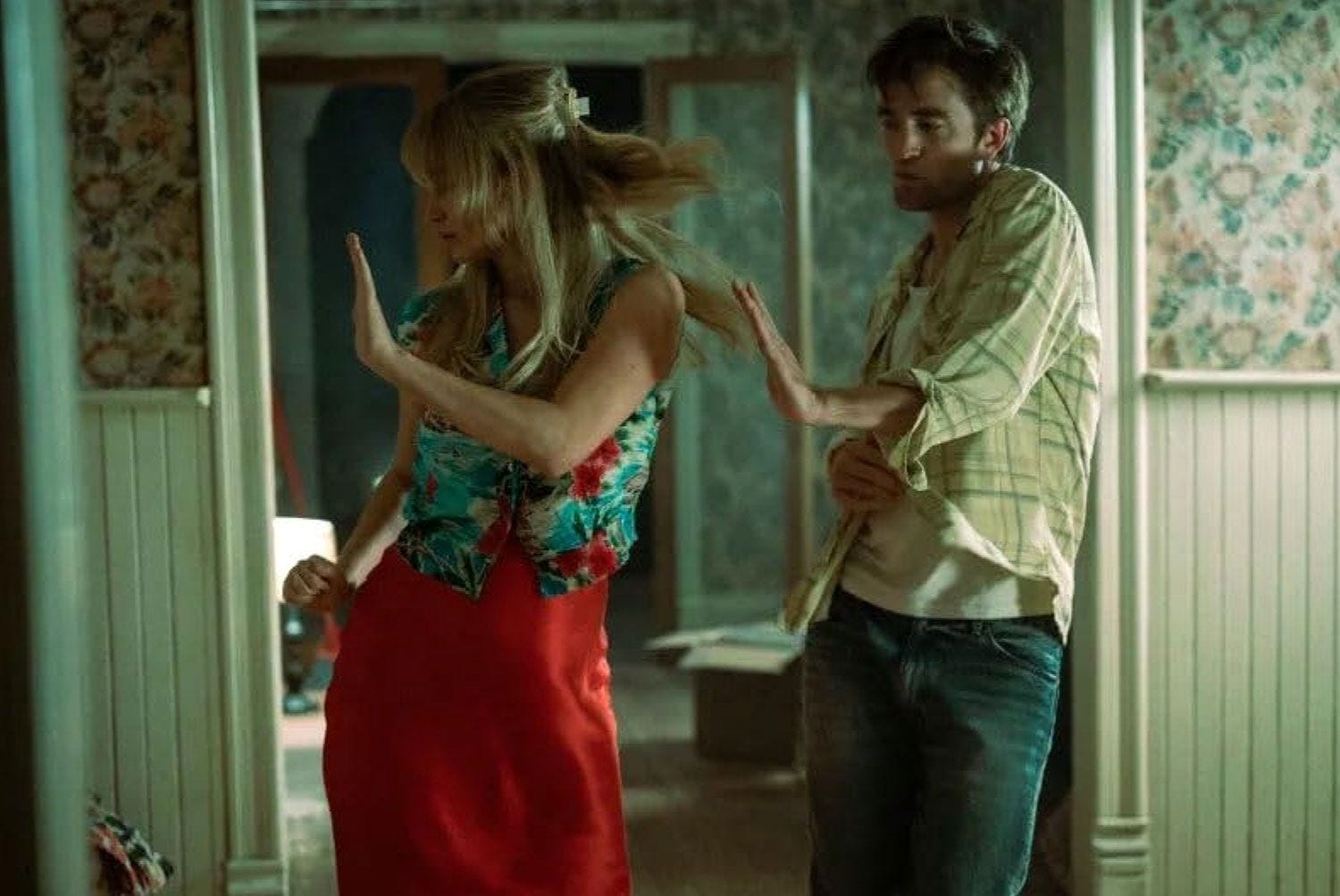
“It was reassuring that there is never any question of Grace’s love and attachment with her son, it is everyone and everything else that she seems to no longer relate to and detaches from,” reads a review by the APP3, pointing out another part of the film that I found particularly telling. In some ways, it seems unafraid to go into the really terrifying and really horrifying aspects of what it means to be sick in this way: Grace hurts herself repeatedly, kills a dog, alienates everyone around her, destroys part of her house (and her hands in the process). She is impossible to understand from the outside, and this erraticness is a function of her state of mind, her postpartum depression, her contingent psychosis. But a line is drawn here, repeatedly, in the film – she loves her son, there is no questioning this, almost as if the film is afraid to. Not that Grace is afraid to, but that the film is repelled from the very idea of it. Despite all its posturing towards the expansiveness and chaos and ostensible disaster of Grace’s progression into losing touch with reality and with her life, this is a line in the sand, a point where the insanity and drama of it all would stop being acceptable.
There’s nothing wrong with it, obviously, and in fact it’s likely quite realistic. But there is something nefarious to me about the pains the film goes to to hold onto this fragment of realisticness, this domestic, idyllic, patriarchal fragment, especially in the midst of a narrative that is, if nothing else, vibrant with destructiveness and fractallation. Why can’t she hate her baby. Why can’t she have trouble connecting with him? The only real reason the film offers (other than some bioessentialist implication about motherhood) is the tether he offers to her late father in law, whose relationship to Grace was one of the most touching and affective parts of the film (along with her scene with Pam, doing her hair) – and in all honesty, I can’t tell if I found it underexplored because it was, or because I loved it so much I simply wanted more.


I’ve seen people describe the film as “frenetic”, “frenzied”, and a classic, “feral”, and while it might texturally and mechanistically be these things, I found it mostly insubstantial. In terms of positives, the acting was spectacular, Robert Pattinson being a feet guy was spectacular, Sissy Spacek was spectacular, the baby was unreasonably adorable. In particular, each of Grace’s scenes with her in laws were touching and forgiving and gentle and emotional, and I cried in the first 30 minutes of the film when Harry touched her belly and asked, full of wonder, “Is it a baby?”, and I cried again when they finally told us the baby’s name. I wish the film’s reception had more to say about this tender throughline in the film, but if I’m honest, it seemed the film itself was too distracted from it, preoccupied instead with domesticity as (selective) prison, mental hospital as prison, womanhood as prison, insanity as a conduit for something that looks like permission — something that, in reality, more closely resembles a caricature.
Some more on film:


Jesse Hassenger, “Jennifer Lawrence Goes Feral in the Beautiful, Frustrating Die My Love”, Paste
Rory Doherty, “Die, My Love Review: Lynne Ramsay’s Elemental Study of a Woman in Freefall”, AnOther Magazine
I know that an explicitly medical or medically adjacent organisation will have a necessarily different and specific outlook towards reviewing a film, and their perspective, understandably, is intensely focused on the wellbeing of the viewer — that is, a specific kind of viewer, and their presumed experiences and preoccupations. I haven’t gone into it in depth for this reason, but I did find this context (one that heavily centers “lived experience”) to be a useful place in which to situate a critique of this aspect of the film, precisely given the focus on health and wellbeing, given the questions that arise as a result of what that can look like, and what media allows it to look like.